The repeater problem has been tracked down. Would never have found it on site. We won’t mention how many hours this has taken.
Solution – the audio input transformer had been burnt out. Originally I thought it had just failed but on replacing the transformer the next one also died. The problem was a blob of solder on the socket for the exciter that was shorting the +12V supply to a bridge connection for the input of the audio. Unfortunately it was intermittent. After putting a third transformer in (supplies getting thin) and resoldering the joint to get rid of the surplus solder there was no longer 12V finding its way onto the audio transformer and burning it out
I have rechecked all levels and adjusted powers on the units. The repeater was re-installed on Tuesday 16 July 2019. Audio working fine.
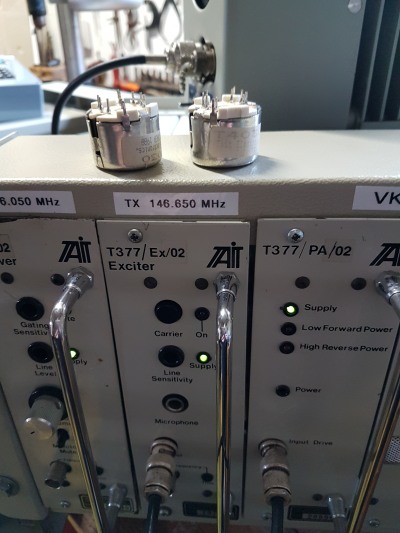
Defunct transformers shown on top of the exciter. The wire is VERY light gauge
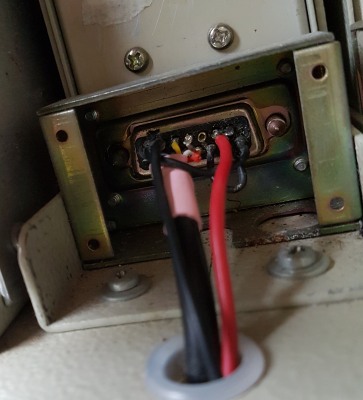
The problem socket. +13V red connector above and immediately below the centre tap of the transformer
You’ll note that the map is missing. I’ve been experimenting so that it would become interactive. Unfortunately Google now charges for use of an interactive map although the first $200 worth is free.
I’m looking into it but reluctant to put my credit card to the test. I’m looking at alternatives but as we all know the Google Maps is the best.
Hang in there I’ll see what I can do over the next few weeks. I’m a beginner at WordPress.
The Heywood Rally will require us on Saturday 27th April only. It’s an early start at 7:00AM. Peter VK5BE is managing this event.
Communication will be via the Portable repeater which operates on the Willalooka frequency 147.350 (your receiver) and 147.950 (your transmitter). Peter and Colin will have checked out communications the week before (20/4/19) and it is expected that the repeater will cover the required area.
The repeater has a 1 second tail but no beep. It has a 10 minute timeout.
The repeater is running on two antennas – both folded dipoles with the receiver on top so it’s expected that a handheld should get in okay.
The Generations in Jazz event is on from 3,4,5 May. Andrew VK5KET is managing this event. Volunteer times to be advised.
The portable repeater is being placed approximately 1km from the Generations in Jazz site and will provide rock crushing signals to the area. Again the frequencies are 147.350 (listen) and 147.950 (transmit).
On Sunday Tom VK5NFT, Alan VK5ZLT and I (VK5DJ) travelled to the Willalooka site. An 8:15AM departure was a bit much for DJ but he managed it. Tom drove and we arrived on site at 10:20AM. We were pleased to have a police escort for a little while – most appropriate for such an important visit.
The aim was to find the cause of the mixing product from 3WV, identify the changing signal strength on the Willalooka transmission and fix the noise that occasionally opens the Willalooka mute and propagates around the whole network. Not a bad list.
What did we find? Not much.
With the aid of his antenna analyser Tom checked the two repeater antennas, viz. the main one near the top of the tower and a temporary test antenna lower down. Both tested with an SWR of 1.2 at the TX frequency but about a MHz higher the SWR was 1:1. So the SWR favoured the RX rather than the TX. The sweep was broad so we decided that the antennas were near enough for government work.
One possible problem found was the antenna coax going into the cavities. It seemed to rotate within the plug. Further examination revealed threads of outer that may have been shorting out to the inner. Tom re-terminated the coax and tightened the nut, we felt much better about that. We checked all plugs for firm connections. Next John got out his DSA815 spectrum analyser/tracking generator and used it to sweep the cavities. The passband and notches checked out and when the cavities were reconnected to the TX and RX no receiver de-sense was evident. VK5ZAI at Kingston reported favourably on access.
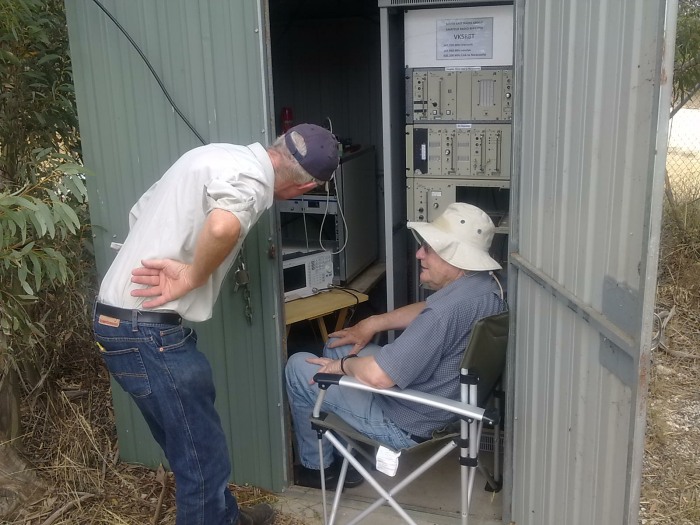
Alan VK5ZLT and John VK5DJ discuss the cavity display
The repeater was re-assembled, connectors tightened and put on the original antenna. The mute was tightened a whisker to avoid noise opening the mute. It may be a little tight and cause chopping but better than noise holding up the network. We left the site about 1:30PM.
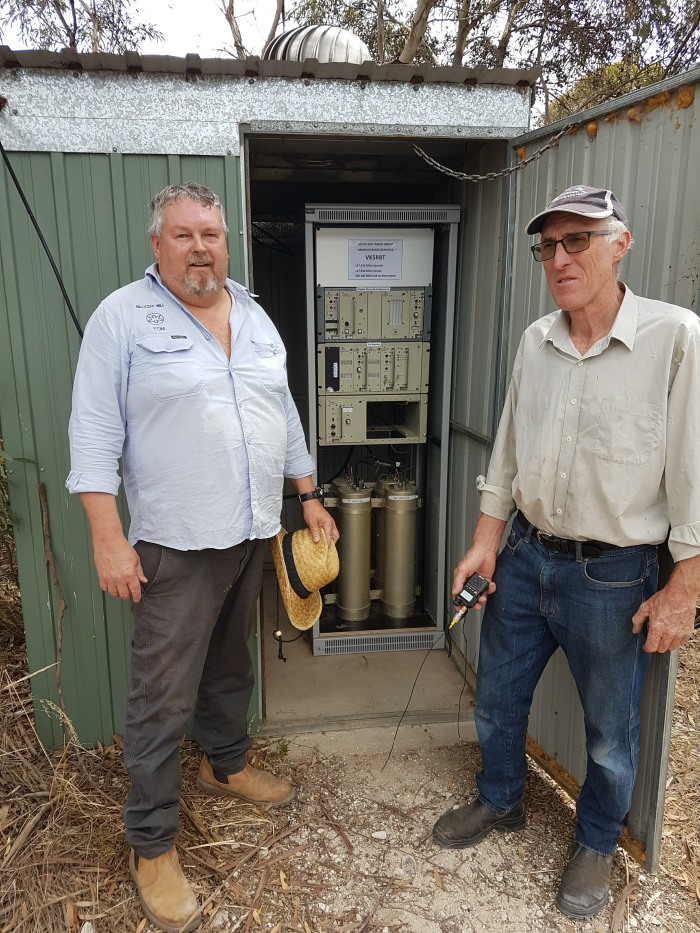
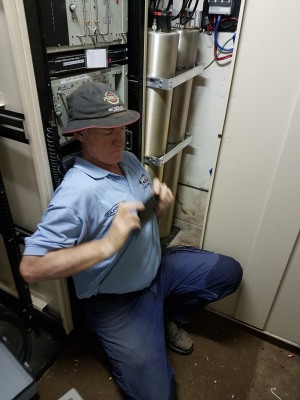
Tom VK5NFT and Alan VK5ZLT before closing up for the day
We thank Tony VK5ZAI for providing test signals during the day’s exercise. It makes a big difference having a distant station.
How to Tune a Band Pass Cavity using a DSA 815 Spectrum Analyzer
The above Youtube clip provided by Tom doesn’t apply to our cavities as ours are passband with a notch. Ours are more critical to tune, however it does give an idea about what is necessary for passband only.
Our cavities have a passband for the RX and TX but they also have a notch in their response 600kHz away. TX cavities have a notch on the RX frequency to remove transmitter noise, while receiver cavities have a notch in their response to remove the carrier. The video does show how to adjust the impedance match of the links and I haven’t done this in the past just adjusted the links for least loss. It might mean the same but in the short term I’ll practice this before next having to do this at a site. Never too young to learn.
At the meeting on 1/2/19 I described how we might use the club’s antenna analyser to best effect.
An important part of using the analyser is to understand the idea of standing waves.
I found this good illustration on youtube:
Hang in there, it’s a little slow moving but the illustration towards the end gives a really good visualisation of standing waves when there is a correct load and an open circuit.
How to tell if your SWR bridge is misleading you. Have on hand an extension length of coax. It should be a ¼ wavelength long for the band you are experimenting with. After measuring your SWR, insert the extra length in the line – this moves your testing point 1/4 wave along the coax to a different point on the standing wave.
Here are some useful lengths:
6M band use a length of 1 metre, 2M band use 340 mm,70cm band use 13cm.
It’s not too critical. Now if your two SWR readings are similar (e.g. 1.2 and 1.3 then you probably don’t have a big problem but 1.2 and 2 would be unacceptable and require more investigation.
To actually calculate the length of the 1/4 wave section the formula is: 75*0.67/freq in MHz and the answer is in metres.
e.g. for 2M it’s 75*0.67/144.0 = 0.348 metres
I’ve used 0.67 as the velocity factor, this is true for many coax cables. Heliax is more likely to be 0.8.
Peter VK5BE finding the best spot to get a good photo of the whole cabinet
Peter VK5BE and John VK5DJ visited the VK5RMG site on Monday 7th January 2019. This followed a visit the previous day to install the new link chassis and filters.
The link receiver from Naracoorte was program damaged (it lost its default frequency). A quick burst with the programmer at home and all is sweet. The whole system is now working with a somewhat faster ID. That’ll test your CW skills.
WSJTX is now in a new version 2.0 and is no longer compatible with previous versions.
If you are having trouble decoding signals it may be that you don’t have the latest version. Update and it’s like magic, back to copying people and working them again.
After meeting President Peter at Penola on Friday 12/10/18 at 8:00AM to collect the antenna analyser and climbing harness, we refused to have him in the car as he appeared to be near death with the flu. We sent him home to bed.
Our working bee began in earnest at Naracoorte to remove the backup antenna from the tower at VK5RNC. Tom VK5NFT climbed while John VK5DJ manoeurved the ropes and avoided a nose bleed caused by climbing higher than 1 metre.
Once at Willalooka we were joined by Alan VK5ZLT with his recently (that morning) finished 2* 5/8. A quick test with the club’s antenna analyser showed a nice broad banded response with SWR less than 1.2VSWR across more than 5MHz and relatively low reactance across the same spread.
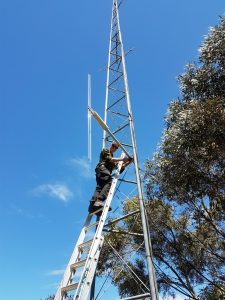
So with the aid of his ladder Alan ascended to a lofty height of 6 metres to temporarily attach the antenna. The antenna replacement was necessary as we currently have intermittent problems with the main antenna losing signal strength at a distance and mixing interference from an AM station near Horsham. We suspect a poor connection at the antenna or damaged coax. The working bee was held to establish a test if the main antenna/coax is the cause of the problem.
Unfortunately an interference problem at one site has an effect on the whole four linked repeaters. We now need to monitor for a few weeks before tackling the next step.
Results as Tom and John travelled south indicate we haven’t lost much (if any) range as a result of the low antenna, although toward Kingston it may well be shaded by the tower.
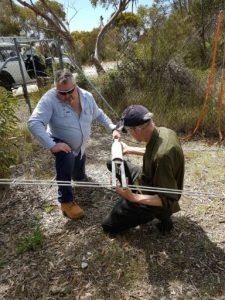
Tom and Alan examine the new antenna
Alan VK5ZLT works on the installation
What’s next? Once we know where the problem lies we’ll get a tower climber to replace the old antenna and install better coax than the existing RG213.